I was recently contacted by a student who had taken my Intercultural Competencies course last Fall.
In their email, they asked for clarification on the following topic:
Is it alright to use the terms Afghani or Pakistani or, if I wanted to refer to individuals from these countries, should I say "Afghanistan citizens or Pakistan citizens" respectively?
Their reasoning: I look at other nations such as Australia and Israel which are commonly labelled as Aussies or Israelis and understand that those are accepted in North American society.
They ended with: I would like a professional opinion as to whether I can use a shortened term (even if only in an educational conversation!).
I love getting these requests because as an instructor of Anthropology (and its concepts) and an intercultural competency facilitator, I find that lacking appropriate vocabulary is one of the biggest deterrents from having conversations about "race", racism, exclusion, and the like.
I responded to the email as follows:
Short answer: Yes, you can use these shortened terms is certain situations.
Long answer: In my opinion, and based on the research I conducted, the terms Afghani or Pakistani are absolutely acceptable terms.
For example, "I'm of Afghani or Pakistani origin" is fine.
These terms would also be appropriate if, for example, you talking about larger demographic trends.
For example, "One of the largest refugee group to come to Canada were Afghani refugees..."
The issue is when you start using these terms to stereotype a group of people.
For example, "I think all Afghani (or Pakistani) people are...".
How would you have responded? Tweet us at @anthrolens or email us at anthrolens@gmail.com.
10 April 2017
06 April 2017
The Return of Support for Acquiring a Liberal Arts Degrees: An Anthropological Perspective
There have recently been a spate of news articles discussing the importance of liberal arts degrees and graduates' chance for success:
- Liberal arts degrees are here to stay (The Globe and Mail, March 13, 2017)
- Why liberal arts degrees are more valuable than you might think (The Globe and Mail, March 7, 2017)
- A Liberal Arts Degree Is More Important Than Ever (Forbes, November 16, 2016)
- Liberal arts education in the Age of Trump (The Washington Post, December 30, 2016)
- Revenge of the arts: Why a liberal arts education pays off (Maclean's, July 26, 2016)
In a recent article by Brock scholars, Norton and Martini (released 2017) argue that: "Canadian university students tend to endorse employment-related reasons for attending university ahead of other reasons such as personal satisfaction or intellectual growth." In their study, first- and fourth-year students placed "a greater emphasis on benefits related to career preparation and economic advancement than those associated with learning and self-improvement." However, when asked to evaluate the importance of a comprehensive list of degree-related benefits both groups of students endorsed the value of many of them, including those related to learning and self-improvement. When discussing why students might focus on so-called employment-related learning, the authors argue that "harsh economic realities and high unemployment rates for young adults, coupled with large increases in the perceived cost of a degree, may also underlie the fact that students endorse career-related benefits above all others" (Norton and Martini, 2017:10).
I read Norton and Martini's work as part of this larger discussion of the usefulness of liberal arts degrees of which anthropology finds itself included, if not closely related.
As advocates for the use of anthropology and its lessons, literally everywhere, the requirement to prove the usefulness of anthropology as a discipline that makes students ready for the workplace seems ridiculous. But in thinking back to my own education, I was rarely told (if ever) about the skills that I gained through my degree (beyond critical thinking). While we're talking about an education that at the undergraduate level ended just over 15 years ago, neither my Masters or Doctoral training provided me with the ability to articulate these skills either.
Follow this link to Simon Fraser's page on Skills in Anthropology which you might want to feature on your next resume and cover letter.
Quick links and further reading:
Quick links and further reading:
- Cole Norton and Tanya Martini. 2017. "Perceived Benefits of an Undergraduate Degree," The Canadian Journal for the Scholarship of Teaching and Learning. 8(1).
- Simon Fraser University's Skills in Anthropology
- More from anthro everywhere!:
- What are Anthropology jobs? (23 February 2017)
- VPhD career finder (5 December 2016)
- Articulating the Anthropological Toolkit to Non-Anthropologists (15 September 2016)
- Advice for Grad Students page


03 April 2017
When Cognitive Mapping and Life Histories Meet
Anthropologists use life histories as a means to shed light on larger systems through the eyes of one individual, over time. Atlas Obscura author Lauren Young recently reminded readers of Michael Druks work, called Druksland. This portrait captures Druks' life story through cartography.
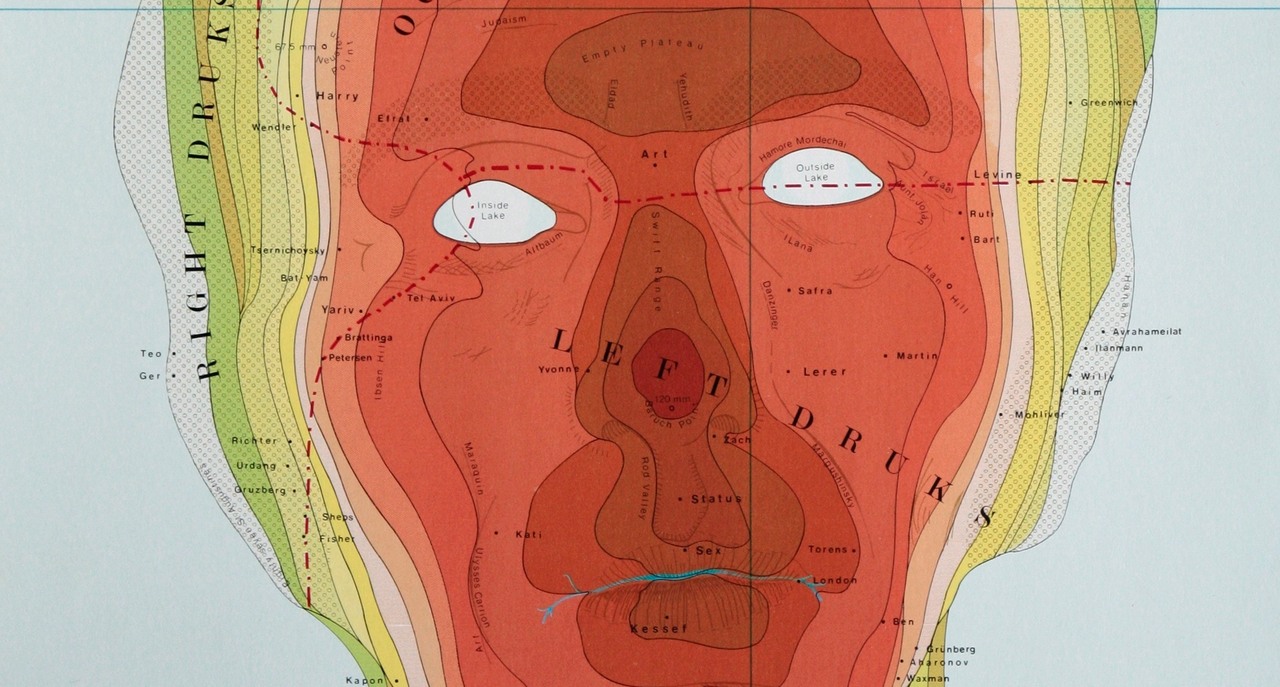
Young writes: Outlining the shape of his head, Druks’ conceptual map incorporates features you would see on a topographical map, including coordinates, bodies of water, and a map legend. Yet the map also serves as an unconventional self-portrait, the coordinates corresponding to major life events, significant people, and important institutions. Druks shows how the contours of a face could be a more complex terrain than any geology on Earth.
This is an interesting example of a medium where cognitive mapping and life histories may meet.
Young writes: Outlining the shape of his head, Druks’ conceptual map incorporates features you would see on a topographical map, including coordinates, bodies of water, and a map legend. Yet the map also serves as an unconventional self-portrait, the coordinates corresponding to major life events, significant people, and important institutions. Druks shows how the contours of a face could be a more complex terrain than any geology on Earth.
This is an interesting example of a medium where cognitive mapping and life histories may meet.
Subscribe to:
Posts (Atom)