Showing posts with label fieldwork. Show all posts

29 January 2018

Ethnography & Case Study Research: Saying yes to the project

Over the past few Mondays, we have been posting on the recent case-study research project I worked on with OCWI. Working with OCWI on this short-term project was an opportunity


In this post, I want to reflect on one more unexpected learning opportunity that came out of this experience: what it means to say "yes" to a new project.

What did it look like to say "yes"?


Interestingly, I hadn't applied to OCWI for this research contract. In fact, I had applied to the organization a few months earlier for a different research role, and had OCWI keep my resume on file. So, when I got an email from my future supervisor at OCWI about this position, it was unexpected, and at the time I wasn't sure if I would be able to juggle more work with my already busy teaching schedule.

Even so, I felt like it was important to meet for an interview to network, learn more about the organization, and learn about the proposed project. I left for the meeting telling myself that I would probably have to turn down the opportunity, but it would be good to "show my face" and let this organization know I was interested and had important skills and experience to offer.

In the meeting, as soon as I heard what the project would be about... I was sold.

Not only was the program I was asked to write a case study on reflective of my previous research interests and areas of expertise, but it was also a chance to gain valuable work experience with this research network, and to actually do field research again -- after years of writing my dissertation, and then the time-consuming teaching duties entailed in preparing new courses year after year.

I immediately began calculating how many hours I could squeeze out of my week, and weighing whether or not I could realistically complete this work to the high standard I would want. I was up front with my soon-to-be supervisor about my availability, my enthusiasm, and interest in this project. When I left the meeting, I had all but signed the contract.

Thinking about what it means to say "yes"


Two months later, I met with my former PhD supervisor for lunch. As I told her about the project I was then deep in the middle of, she remarked how one of my strengths was my willingness to try new things, to take on new challenges and say "yes!" to opportunities outside of my comfort zone.

This comment really struck me because I hadn't considered this willingness to try new things to be an out-of-the-ordinary strength for a) an anthropologist, and b) a recent PhD grad today.

Anthropological adventurousness?

As a relatively shy person, I have always found conducting social research to be a step out of my comfort zone. Connecting with new people and asking them questions about their lives was never something that came naturally to me.

I chose to become an anthropologist because I loved what this approach to social questions could tell us, not because I love talking to strangers. Yet, now that I am an anthropologist, I know that in order to be an effective social researcher, I need to step out of my comfort zone sometimes.

Enacting (neoliberal) agency in the face of neoliberal structures?

Secondly, as a recent PhD grad in a highly precarious academic labour market, many of my conversations with colleagues over the past several years have focused on how not to get stuck in adjuncting purgatory. My approach has been to apply for interesting opportunities that seem like a good (if not perfect) fit... We are all expected to be "entrepreneurs of ourselves" in a neoliberal society, right Aihwa Ong?

I was therefore surprised to hear that it seemed that many of these same colleagues aren't doing the same. One of the great strengths of someone who, for a very long time, identified as a professional student is that I am able and willing to learn new things!

On the other hand... the more I thought about "adventurousness" as a strength, I also found myself thinking about the structures that limit the ability to say yes.

I was only able to take on this new research project because of the modicum of stability I have this academic year in teaching the same courses. Instead of dedicating 8-20 hours a week in preparing new lectures and assignments on top of my regular teaching duties, these are mostly already in place -- meaning that time can be given to exciting new research opportunities.

If this opportunity had fallen into my lap during the two previous years, I would have had to turn it down during the academic term. In working as a professor, I love the opportunity to teach anthropology to my students, but as an adjunct I work in a structure that has often limited my ability to do other kinds of "professorial" tasks (such as supported time for writing and research).

Lessons from saying "yes" to the project


Taking on this research contract has been a valuable experience, both personally and professionally. Yes, there was a bit of a learning curve to this project for me as I engaged with new research approaches and methodological vocabulary. Importantly, I didn't need to identify these problems and their solutions all on my own. A key lesson has been that being up to a new challenge doesn't mean tackling it alone.

I was hired because my supervisor/ co-researcher recognized how ethnography (and an ethnographer) could add a valuable dimension to OCWI's series of case-studies. So, I decided to approach this opportunity as an ethnographer; in addition to making sense of the community-based program at the heart of our case study, I would also make sense of the unfamiliar culture of this research network.

In approaching my co-researcher/ supervisor at OCWI as a key informant, I positioned myself to ask naive questions, check-in about my understanding of the project and directions, and draw on her local cultural expertise. For instance, she suggested methodological resources on program evaluation and case study research, facilitated introductions to key research participants in our community program, and helped orient me to key landmarks in the grey literature. Rather than getting caught up in "imposter syndrome" in an unfamiliar field, I was instead doing what I have been trained to do as an anthropologist.

So, to close out this post -- the last in this series until the research communications from this case study are published -- I would like to say "thank you!" to my supervisor/ co-researcher, Dr. Michelle Coyne, and OCWI for these enriching opportunities to think about the connections between Ethnography and Case Study Research.

Further reading:

23 November 2017

Sample Boilerplate Language for Ethnographic Ethics Proposals

Blogger Jennifer Long has been spending lots of time (too much time) writing ethics proposals these days. However, many university-related ethics boards have very useful tips, tricks and resources to help researchers along.

So if it's your first or fortieth kick of the ethics proposal can, check out your institutions REB home page before pulling out your hair and throwing items across the room.

Although I'm not conducting ethnography at this time, McMaster's REB has an ethnographic boiler plate template for ethnographic studies. It's a useful document with tidbits such as these for the methods section:

This project will be based on standard methods of ethnographic research in the discipline of anthropology. Researchers in cultural anthropology (ethnographers) engage in participant observation, a fieldwork method based on social relationships between individuals and the ethnographer, in which the ethnographer assumes the position of a student or apprentice who learns through participating in everyday activities with community members and observing social life.  This participant observation component of my research is essential because it will provide the broad social and cultural context for my specific research questions that deal with [INSERT YOUR RESEARCH TOPIC HERE].

Following the general methodology of participant observation, this study will involve several specific tasks.  From approximately [INSERT DATE] to [INSERT DATE] I will reside in [INSERT LOCATION(S) ] where I will participate in many aspects of community life including [INSERT DETAILS].  
Because of my [INSERT DETAILS, IF APPLICABLE], I already know many people in [INSERT NAME OF LOCALITIES] and I expect that I will have no trouble integrating into the community.  I also plan to [INSERT DETAILS]. 

Follow the link in the Quick Links to see the whole document. Many thanks to its original authors from the Anthropology program at McMaster: Dr. Badone and Rebecca Plett.

Quick Links:

16 November 2017

One Size Does Not Fit All - Preliminary Findings

On November 13th, anthro everywhere! blogger Jennifer Long continued her One Size Does Not Fit All series where she provides readers with an overview of her new pedagogical research project in collaboration with Ms. Silvie Tanu Halim at the W. Booth School of Engineering Practice & Technology. This research explores mature and non-traditional students' educational experiences where we seek to understand how these perspectives differ depending on our medium of instruction: online (synchronous, asynchronous), or face-to-face.

We left off on Nov 12th discussing how blogger Jennifer Long invited students to participate in their survey.

Although the survey is still open, the following is a line graph outlining when we received our 86 responses (thus far):
Figure 1. Responses according to date
As mentioned in previous posts, although we did use incentives to encourage participation, it appears that most participants decided to take part soon after the project was introduced by Blogger Jennifer Long.

Dr. Long attended Ms. Tanu Halim's classes on November 07th (online, yes, I made an appearance in the online course) and November 9th (in class). November 7th sees the greatest spike. This spike can perhaps be accounted for, if we consider that students were already in front of their computer when they were invited to participate in an online survey. The second spike appears to be on the Sunday or Monday following my visit to the classroom (after the weekend) on the 10th.

I also thought I'd share some of the aggregated information about those taking part in the survey. When speaking about mature students, it became apparent that the majority of our respondents were between the ages of 21 and 25.
Age Ranges of Participants thus far (Nov 16 2017)
It will be interesting to compare this information with that of other scholars and how individuals 25+ experience education at SEPT when compared to those in the 21-25 category.

What is also informative are their responses to preferences to learning:
Learning Preferences of Mature Students
It will be very interesting to delve into their comments to understand what we see here, that more respondents prefer to learn new course material in-class rather than online.

Check out future posts to learn how the researchers will collect and analyse their data -- or see all posts in the One Size Does Not Fit All research series on our updated page Special Series: Ethnography & ... (formerly "Ethnography & Tourism")

Want to use these findings for your own work? Please cite this source as follows:

  • Long, J., & Tanu Halim, S. (2017, November 16). One Size Does Not Fit All - Preliminary Findings [Web log post]. Retrieved from https://anthrolens.blogspot.ca/2017/11/one-size-does-not-fit-all-preliminary.html

13 November 2017

One Size Does Not Fit All - Encouraging Participation without Coercing Participation

We take up from where we left off on November 8th when anthro everywhere! blogger Jennifer Long continued her overview of her new pedagogical research project in collaboration with Ms. Silvie Tanu Halim at the W. Booth School of Engineering Practice & Technology. All posts that begin with 'One Size Does Not Fit All' describe a project which explores mature and non-traditional students' educational experiences and seeks to understand how these perspectives differ depending on our medium of instruction: online (synchronous, asynchronous), or face-to-face.

We left off on Nov 8th providing a final overview of our survey questions about educational experiences and preferences. Today, we're going to discuss how blogger Jennifer Long invited students to participate in their survey.

As discussed in previous posts, the target population of our research are our own students. To be more specific, they are Ms. Tanu Halim's students. To conduct this research, Ms. Tanu Halim and Dr. Long had to submit an ethics proposal to our university's board of ethics for research projects involving human beings. This is standard practice for any researchers working with consenting individuals. Unsurprisingly, our research board wanted to understand how we'd be mitigating the pressure students might feel if their own instructor is asking them to take part in research.

First, as researchers, we had to outline how our research was voluntary, as in, our participants would not be negatively effected by choosing not to take part. Therefore, our letter of consent included the following text:

Your participation in this study is strictly voluntary. This study is not an assessment component for this course; therefore, your responses will not be evaluated in any way during this study. As such, your grade for your class will not be negatively impacted if you choose to withdraw or not participate in the study. 

We also outlined the potential risks facing students if students chose to take part. For this project, we identified the potential of both psychological and social risks. The following is the text describing how we will try to mitigate these risks:

Psychological risks:
Participants are informed in the online invitation and Letter of Information that this study is voluntary. If worried about the social risk, students are informed in the invitation text and Letter of Information that they can access the survey and choose not to participate while still contributing to the 70% participation threshold. 

Social Risks:
Further, if participants wish not to answer particular survey questions, they will have the option to skip any question they are not comfortable answering. 

As described in the psychological risks, we're awarding everyone in the class a bonus mark once we've hit a 70% response rate threshold. To maintain anonymous responses, we've decide to dole out these bonus marks to everyone as we're not collecting their identifying information. This could however make some students feel forced to take part and therefore, we've included an option where students can click on the survey and then decide not to take part (selecting 'no' to the consent screen). In so doing, these click throughs to 'non consent' still count toward the 70% threshold.

There has been some debate regarding how much incentivizing participants will influence the responses researchers receive.  As becomes evident, Ms. Tanu Halim and I had to walk a fine line of trying to entice students to participate (online surveys suffer from low response rates) and overstepping our boundaries as instructors by influencing our students to take part.

Another step we're taking to encourage realistic responses and experiences is to collect this information anonymously.  In taking this approach, we're hoping that our students are able to willingly take part and provide us in-depth information about their learning experiences and preferences in ways that are meaningful to them. Further, if we don't know who took part, we can't give preferential treatment to anyone.

Finally, when inviting students to take part in our survey, Dr. Tanu Halim left the room while Dr. Long provided a brief explanation about the research and its project plan. This 'script' is outlined again in our ethics proposal, as a means to avoid undue coercive behaviour. This approach allows students to ask questions and speak to any concerns they may have away from the eyes and ears of their professor. Blogger Jennifer Long told the students about the study and where to find the link, but students have the choice to take part at a later point in time and not, for example, under Dr. Long's 'watchful eye'. This would present few options for some students.

Check out future posts to learn how the researchers will collect and analyse their data.

Want to use any ethics phrasing for your own work?
Please cite this source as follows:
Long, J., & Tanu Halim, S. (2017, November 13). One Size Does Not Fit All - Enouraging Participation without Coercive Participation [Web log post]. Retrieved from https://anthrolens.blogspot.ca/2017/11/one-size-does-not-fit-all-encouraging.html


08 November 2017

One Size Does Not Fit All - Research on Mature Students' Educational Experiences

In a follow up from our post on November 2nd, anthro everywhere! blogger Jennifer Long continues to discuss her new pedagogical research project in collaboration with Ms. Silvie Tanu Halim at the W. Booth School of Engineering Practice & Technology. 

Check out last week's posts to learn the context behind our study. In a nutshell, we seek to know more about mature and non-traditional students' educational experiences  and, to explore how these perspectives differ depending on our medium of instruction: online (synchronous, asynchronous), or face-to-face.

We left off on Nov 2nd by showcasing some of our questions about the demographic information of our participants. In today's post, we get down to the nitty-gritty of the learning experiences and preferences.

The rest of our questions deal with student experiences of online learning. Therefore, we have to narrow our participant group to those with online experiences. 

Question 8 follows: Have you ever taken an online course (including high school, college or university courses, training, or workshops) in the past? Yes/No

Here, we put a little logic into things, if a student answers 'no', they are thanked for their time. If they answer yes, students will continue on to the question set below.

If student participants select yes, they are asked to fill out a matrix  with answers between not very effective (all the way) to very effective for the following items:
  1. How effective do you find time spent attending online lectures (in synchronous [defined in survey] format)?
  2. How effective do you find time spent watching pre-recorded lecture videos (which you can watch at any time)?
  3. How effective do you find time spent reading through course notes (for comprehension of material)?
  4. How effective do you find time spent working through problems in the course textbook (through self-directed learning in complement to online resources)?
  5. How effective do you find time spent discussing course content with student peers? 
  6. How effective do you find time spent discussing course content with your instructors?
Then we ask them questions about their use of resource materials for online learning: 

  1. Do you prefer synchronous or asynchronous learning for online courses? Why?
  2. Do you use the accommodation/preference options on the pre-recorded videos (e.g. slow down, speed up videos)? 
  3. Do you replay videos if you do not understand a concept? Why (or why not)? 
  4. How important is it to have an online community with your student peers? Scale of not at all to very important.
As it happens, our survey opened up last night. Check out some of next week's posts to learn how blogger Jennifer Long invites her colleagues students to participate and how we work to avoid undue pressure on our student participants to take part in our survey.

Want to use these questions for your own work? 
Please cite this source as follows:
Long, J., & Tanu Halim, S. (2017, November 02). One Size Does Not Fit All - Research on Mature Students' Educational Experiences [Web log post]. Retrieved from http://anthrolens.blogspot.ca/2017/11/one-size-does-not-fit-all-research-on.html

Quick Links:

02 November 2017

One Size Does Not Fit All - Anthropological & Pedagogical Research on Mature Students

In a follow up from our post on Monday, anthro everywhere! blogger Jennifer Long continues to discuss her new pedagogical research project in collaboration with Ms. Silvie Tanu Halim at the W. Booth School of Engineering Practice & Technology. 

Here, we as researchers are interested in exploring the educational experiences and learning preferences of mature and/or non-traditional students and, to explore how these perspectives differ depending on the instruction medium. We left off last day promising to further explain the types of questions would wanted to ask.

As mentioned in the previous post, our population would include students signed up to the Degree Completion Program. These students have completed (at least) an advanced diploma from a College. 

What assumptions do we make about this population? 

As mentioned in the last post, we assume that these students will have more or different competing responsibilities for their time. To expand on this point, we find that the majority of our students do not come straight from a college program but are returning to post-secondary education after having begun their career. Therefore, these students typically work a 40 hour work week, may have dependents to care for, and other commitments on their time.

In their exploration of the role of anthropological knowledge outside the classroom, Coleman and Simpson (1999) find that anthropological knowledge provides: (1) a unique opportunity to hold a mirror up to one's own life circumstances and (2) a chance to reflect on one's personal experiences. However, the cultural outcomes of participating in higher education may generate contrasting relationships outside of school and personal change that is not without a problematic middle-class undertone. Citing David James (1995), the authors warn  that post-secondary participation may very well reproduce a social distance between one's university and home life. Importantly, these authors - using Alison James' work - help us question how a return to university may be felt by some to be a world of new possibilities and for others, an alternative form of personal  displacement and dis-empowerment.

How then, are our DCP students experiencing their education here at SEPT? Are they experiencing a new world of possibilities or personal displacement and dis-empowerment. What is the role of the medium of pedagogy - and how does his affect how these students experience their post-secondary education? 

Below are a list of questions we included in our online survey to help understand the rounded picture of people's lives (borrowed from Coleman and Simpson). Next week, we'll follow up with an overview of the questions around the mediums (paths) of learning:
  1. Your gender (multiple options available)
  2. Your age (range)
  3. Hours per week spent on family and household responsibilities (range)
  4. Hours per week spent on work, work-related activities (e.g. travel), or other weekly tasks (e.g. volunteering, searching for work, etc. ) during a typical (or average) work week throughout the year (range)
  5. How do you prefer to learn new course material? (Options include in class, online, or on your own through self-directed learning (i.e. using course materials to complete tasks at your own pace according to set deadlines)? Follow up question: Why? [Open text box]
  6. How do you learn (new course material) most effectively? Options include in class, online, or self-directed learning (definitions integrated into survey). Why? [Open text box]
  7. As a mature student, how will your educational experience differ from those traditional students entering university directly from high school? [Open text box]

Want to use these questions for your own work? 
Please cite this source as follows:
Long, J., & Tanu Halim, S. (2017, November 02). One Size Does Not Fit All - Anthropological & Pedagogical Research on Mature Students [Web log post]. Retrieved from https://anthrolens.blogspot.com/2017/11/one-size-does-not-fit-all.html


Quick Links:

24 August 2017

Anthropology Podcasting

Heard any great podcasts lately? What about anthropology podcasts?

We've posted about anthropology and podcasting before on anthro everywhere! as a way of communicating ethnography in a different format, as Dr. Lindsay Bell has done with her students. Podcasting can be an opportunity to engage a wider or different audience than text-based communications. The medium and our possible audiences might also challenge us to think through and present theoretical ideas and ethnographic details as a public anthropologist speaking to a perhaps non-specialist audience.

So, what about the podcasts that are already out there? You might be surprised that so many anthropological associations and initiatives have jumped into podcasting to share our insights. From audio versions of academic lectures to more intimate conversations about ideas, here's a by no means definitive list for your listening pleasure:

  • As you might have suspected, the RAI Lectures podcasts are audio files of keynote lectures given mostly by anthropological rock-stars on a variety of topics.
  • This Anthro Life might be the best known anthropology podcast. Episodes run about 20-30 minutes, and are put together by a team of grad students on issues "inspired by Anthropologist Ruth Benedict’s claim that anthropology’s job is to make the world safe for human differences."
  • AnthroPod: The SCA Podcast is hosted by Cultural Anthropology  in line with their open-access format and mission. Many episodes deliver interviews with anthropologists on their work, while others explore particular issues more broadly. Episodes vary from about 30-60 minutes in length.
  • A Story of Us comes from Ohio State's Anthropology graduate students, with series themes from researchers in the department, such as childhood, death, and migration.
  • Anthropological Airwaves is American Anthropologist's new podcast series, and aims to mirror the journal's "four-field, multimodal research, the podcast hosts conversations about anthropological projects—from fieldwork and publishing to the discipline’s role in public debates."
  • Oxford Podcasts from the School of Anthropology and Museum Ethnography. With over 200 episodes since 2010, this podcast showcases lecture and seminar discussions from the department.
  • Thinking Allowed is BBC4's ethnography podcast, which bills itself as "New research on how society works." While the presenter, Laurie Taylor, is a sociologist by training, the focus really is on the value and power of an ethnographic perspective.
  • The Sociological Imagination podcasts from a sociological and interdisciplinary perspective, and is worth including in this list. It's also a great site to mine for further listening, through posts like "The LSE’s remarkable archive of public talks."
  • You can also check out AAA's Podcast Library and its impressive list of archived podcasts, which include episodes covering the four-fields of anthropology.
Inspired to make your own podcasts? Check out this informative piece on the podcasting medium, "Talking Anthropology: Podcasting for the Public," (and Part 2) from Teaching Culture for ideas about how to craft your own and/or bring podcasting into the classroom.

Know about other great anthropology podcasts that should be on this list? Tweet us @anthrolens or email anthrolens@gmail.com. Here are few more from readers like you:
  • Updated - 25 August 2017: From the Relevanth blog, Anthropologist on the Street interviews anthropologists and others about "today’s controversies, debates, and trending issues to examine the hidden cultural forces at play."
  • Updated - 27 August 2017: The Sausage of Science Podcast with Cara & Chris is a new podcast series from the Human Biology Association. This podcast "combines interviews and lectures with and by new researchers and research in science writ large and that applies to those interested in the field of human biology."
  • Updated - 27 August 2017: You might also want to check out The Leakey Foundation's Origin Stories, podcasting "about what it means to be human and the science behind what we know about ourselves and our origins."
  • Updated - 10 November 2017: Thanks to René Herrera for alerting us to AnthroAlert - live on Fridays or catch up on past episodes with this public anthropology project (@AnthroAlert).
  • Updated - 14 January 2018: Have you heard The Familiar Strange podcast yet? Besides having a great name, this project in public anthropology is supported by the "Australian Anthropological Society, and the Australian National University’s Schools of Culture, History and Language, Archeology and Anthropology, and the Centre for Public Awareness of Science." They've got a blog too!

10 July 2017

The Refugee in Anthropological Perspective

Over the past decade, we have witnessed new and ongoing crises around the world that have forced many people to uproot their lives in order to seek refuge elsewhere. On the news we see aerial shots of battered and dilapidated boats overflowing with passengers, or throngs of people on foot carrying their meager belongings, dusty and tired from the long trek. The visual rhetoric we see in these spaces deeply shapes how we understand refugees, and 'their' lives in 'our' national spaces. Through their movement, refugees raise many powerful questions of interest to anthropologists, but also for policy makers, governments, local communities, and for those who endure forced migration themselves.

We've collected here a few interesting resources for discussing anthropological approaches to refugees, especially in light of the more recent and very visible migration of asylum seekers around and across the Mediterranean into Europe.

First, Mayanthi Fernando and Cristiana Giordano's curated "Hot Spot" in Cultural Anthropology on "Refugees and the Crisis of Europe" collects a number of anthropological perspectives on this phenomenon. As they note in the collection's abstract, the "unprecedented" movement of refugees from Middle Eastern and African countries to Europe since 2015 has "turned immigration, asylum, border control, and state sovereignty into interconnected problems, making migration not only a political event but also a media spectacle." The diversity of issues raised in these short articles -- a mapping of "the histories, geopolitics, ethical imaginaries, forms of sovereignty, and patterns of circulation that state categories of crisis and emergency render visible and/or invisible, in Europe and elsewhere" -- recommend them as course texts in discussing a wide range of anthropological questions centred on this highly visible public issue.

In thinking about what an anthropological perspective can bring to understanding this "crisis," I would highly recommend the interview that appeared in Peeps online forum between anthropologists Monica Heller and Sarah Green on "Shifting the global conversation on refugees" (2016).

For other interesting, but non-anthropological sources, instructors might be interested in the New York Times' feature from earlier this year on the the integration of Syrian refugees in Weimar, Germany. While the journalists who wrote this piece spent months in Weimar, this long-form journalism might be interesting to use in also raising the question of how journalistic and anthropological approaches differ.

Lastly, the Refugee Atlas (http://refugeeatlas.com/) is a visual atlas, whose creators suggest could "help to construct the anthropology in motion, referring to crucial aspects of human condition without any recourse to national, ethnic or cultural essentialism."

The Refugee Atlas project is part of the larger "the European History Atlas Under Construction - the transgenerational project of Strefa WolnoSłowa Foundation organized in collaboration with artistic and research organizations from Warsaw, Paris, Bologna and Antwerp." While this is rooted in a fine arts approach to understanding migration, refugees and multiculturalism, the atlas' juxtaposition of diverse and thematic historical and contemporary images and maps may make it an interesting visual for anthropological discussions. The project organizers worked with youth and seniors of both European and migrant backgrounds to explore themes around memory and history in connection to migration. According to the atlas' creators:
The phenomenon of mass migration often cuts across traditional cultural formations, reveals hidden tensions or unmasks shameful continuities. It catches culture in its movement and shows its perpetual fluctuations, irrevocable unrest. This is why making a visual atlas on the experience of migration requires stepping out of both the journalistic news culture, which changes the “refugee crisis” into another viral celebration of the ignorance, and the injunction to always associate the suffering of the oppressed with documentary sensibility.
What kinds of narratives do these images generate, and how might they reflect or differ what we typically see in the news, or in a quick "Google Image" search?

If you have other resources that would be a good addition to this short list, please let us know via email (anthrolens@gmail.com) or tweet us @anthrolens.

Quick links:

06 July 2017

An Anthropologist In Situ Part II: A Business Accreditation Conference

I (Jenn) have recently been reflecting on the ways in which we can bring anthropological knowledge into non-traditional anthropological places - particularly, during conference season. First, I spoke about anthropological ethical standards in engineering classrooms and more recently, when I showcased lessons on intercultural competency during group work at an engineering conference. Just this past week, I attended a conference about accrediting our business program (within the Engineering faculty) and was struck by one unique practice of identifying other conference participants.

When one arrives at this conference, we're given your standard name badge. Like other conferences, the name of the individual (without title) is given and, in smaller font, their university's name. At anthropological conferences like the AAA or CASCA, conference-goers have seen their first name printed in bigger font than any other information in recent years, perhaps to create a more equitable approach rather than singling out or emphasizing those individuals who have risen to anthropological fame (henceforth called the anthro-glitterati ™ anthro everywhere!). This practice of identification and labeling fits into symbolic anthropology where anthropologists study "the way(s in which) people understand their surroundings, as well as the actions and utterances of the other members of their society" (Hudson et al. 2009).

Hudson et al. (2009) describe Victor Turner's perspective of symbolic anthropology where symbols help dictate and allow others to discern and interact with one another. "Turner felt that these "operators," by their arrangement and context, produce "social transformations" which tie the people in a society to the society's norms, resolve conflict, and aid in changing the status of the actors" (Ortner 1983:131).

Jenn's conference name
tag & basic ribbons
It was in this light that I understood the use of ribbons or badges at my most recent conference. As will be further described below, these ribbons allow conference-goers to discern their connection and placement of other conference-goers not only through individuals' and university names but also through the practice of attaching ribbons.

For example, I was told by a helpful and experienced conference-goer that I needed to identify my accreditation region (so that others would know which region I came from) as well as my own or my university's accreditation level (where they stood in their accreditation process, i.e. candidate, accredited, re-affirmation, etc.). You'll see from my badge I'm a first time conference-goer.

Further, if you held a position within the organization, there was a badge for that too, including evaluator, chair elect, etc.

The ribbon station (photo below) was clearly marked in one of the main halls of the conference and included many ribbons:

Ribbon Table

Ribbon choices
In addition to the ribbons describing your rank and geographic category, there were 'silly' ribbons, for example, my ("I heart bacon" and "totes magotes") ribbons:

Jenn's badge with the
addition of 'silly' ribbons

"Are you showing your ACBSP pride today? This attendee certainly is."
From my four day experience of this conference, I noticed that this practice of collecting and displaying silly ribbons was a mechanism to identify and distinguishing oneself from others and was often used as a talking piece either face-to-face or online. Here are three screen shots from the conference's twitter feed:

Tweet from Conference-Goer
#ACBSP2017 Twitter feed:
"Badges - High Impact Practice
I'm hearing about everywhere."


This last photo I took was of two participants who told me that ribbon collecting was tradition at the conference and the longer the chain, the better.

Conference attendees display their ribbons
Thus, as an anthropologist in situ, these identity making practices show a moment in time where individuals are able to identify and distinguish themselves among other conference goers and, I would argue, find new collectivity in the practice of ribbon gathering and displaying.

Quick links and further reading:

08 June 2017

2017: An Ethnographic Renaissance?

I recently read an interview between Smithsonian's Steven Beschloss and sociologist Matthew Desmond. This article detailed Desmond's fieldwork in a trailer park and a rooming house in Milwaukee between 2008 and 2009. There, he conducted fieldwork with eight families and two landlords and, in the words of Beschloss, "captur[ed] how the toxic mix of extreme poverty and economic exploitation can leave individuals unable to keep a roof over their heads."

This article is a series of questions and answers by Desmond whose new book Evicted is recently published. In one question particular to ethnography, Beschloss asks:

What about [...] ethnographies [that provide] not only insights but were part of a progressive tradition to influence social problems?

Desmond responds (this is a selection here):
"If I get down onto the ground with this problem, try and see it as closely as I could and write about it with complexity and humanity, maybe that would make a difference in and of itself.  I am heartened by the fact that we have this wonderful tradition of ethnography and in-depth journalism that’s focused on these moral questions and made a difference."

How accessible is the 'wonderful tradition of ethnography' AND in-depth journalism? Are these supposed to be read as one in the same? Something of a very similar tradition? Is this too traditionalist of a perspective (asking oneself...but is your method informed by ethnographic theory?!?!)?

Deepa S. Reddy, Ph.D. wrote about Ethnography (is) Everywhere! in 2013. Four years ago, Reddy wrote that "ethnography seem[ed] to have acquired a new cachet in the last decade."

She goes on to pose a problem that was originally behind Desmond's answer:
"The trouble is that ethnography has also become industry jargon, used to describe quite a range of qualitative consumer research approaches, often diluting ethnography to simply another way to generate a “real-world understanding” of consumers. The other trouble is that ethnography, classically conceived and thoroughly executed, requires some fairly intensive field studies. Its focus is on studying people and practices in their native contexts. But does this mean that those who cannot immediately commence extensive field studies are stuck at the shallow end of research? Not necessarily."
Reddy then goes on to list a number of ways in which we can draw from ethnographic approaches in a deep (as opposed to shallow) way. Follow the link below to see Reddy's list.

Quick links and further reading:


15 May 2017

Promoting publications behind paywalls... or anthro everywhere! in Anthropologica

Jennifer and Rhiannon at CASCA-IUAES
with Vol. 59, Issue 1 of Anthropologica (May 2017)
What a nice surprise to arrive at the CASCA-IUAES intercongress last week and see our new journal article "Agency and Agendas: Revisiting the role of the Researcher and the Researched in Ethnographic Research" published in the most recent issue of Anthropologica! This article was co-authored by the authors of anthro everywhere! (Rhiannon Mosher and Jennifer Long) as well as Elisabeth Le and Lauren Harding.

This is also an opportune moment to reflect on how we can best communicate about our new article through social media. During CASCA the publisher (University of Toronto Press) had made this latest issue open access, but now that the conference has ended, our article is once again behind a paywall. So, as Aidnography suggests in Don’t post direct links to your new journal article! (17 April 2017), here's a brief description of our latest publication. If you have access to Anthropologica as a CASCA member, or through your institution, we hope that you download and read the full text.

"Agency and Agendas"
"Agency and Agendas" came out of the discussions we had as members of a panel during CASCA 2015 with the late Pierre Maranda (1930-2015) on the researcher as starting point for ethnographic research. Growing out of that early discussion, this article focused in on how ethnographic research is an essentially collaborative project between the researcher and the researched, all of whom exert agency in how they choose to engage with the ethnographic project (or not), and in the service of their own agendas -- which may align or differ from those identified by the researcher in their project. This article doesn't focus on explicitly collaborative research approaches -- like PAR or activist approaches -- but thinks about how ethnographic knowledge is created more generally. In thinking through the diversity of moments that comprise what we come to know through this approach to social research, we find Anna Tsing's notion of "friction" useful, as it "engages not only the ‘‘awkward zone of encounter’’ but also the potentially generative results of diverse, even divergent, agendas and agencies coming together" (Mosher et al. 2017:154). As we write,
Tsing’s friction refers not to conflict or poor relations among the researcher or researched. Instead, friction refers to the idea that our interlocutors are agentive individuals who wilfully take part in, and influence, our research. How our interlocutors participate (or refuse to participate) deeply affects our work as ethnographers (Mosher et al. 2017:146).
In this article, we wanted to try to move beyond simply discussing reflexivity and positionality, and instead consider how the people who participate in our research co-create what we consider 'the field' -- how this interaction deeply "enables, shapes, redirects, and limits the kinds of research we may ultimately produce." Through drawing on our own research experiences, we argue that what we come to know through ethnography "is in no small part due to the agency and agendas of those we recruit as participants in our studies" (Mosher et al. 2017:147). As authors, we tackle these questions and hope to open up this discussion through addressing considerations of:
  • how our potential participants shape and direct our access to data. Our interactions with the people, places, and issues that we seek to understand are deeply entangled in the iterative process of ethnography.
  • what might be called the "observed" effect on our research. In what ways are we and our research agendas/ approaches shaped by becoming an object of scrutiny among our research community/ participants/ informants? 
  • the adaptation of ethnographic methods to non-academic research contexts. With the growing interest in ethnographic methods in industry, how can anthropologists pursue "thick" ethnographic relationships and insights in the context of rapid, industry research timelines (including where our research contacts have been pre-arranged by a third party)?
  • the afterlives of research. How do the reputations of past researchers among the communities we study impact or frame the kind of research we do in the present? How might our own research findings become incorporated into yet unimagined future projects and agendas, including among our former research communities?

Quick links:

24 April 2017

Bringing anthropological ethics into the classroom

With the Canadian Anthropology Society Conference next week comes CASCA's Spring issue of the network's newsletter, Culture.

One item that caught our eye in this issue was Eric Henry's description of a case-study discussion activity he created for students to work through some of the potentially thorny issues anthropologists and linguists face in the field: Targaryen Ethics: A Case Study in Linguistic Appropriation Using “Game of Thrones”

Henry writes that in his linguistic anthropology course,
language appears to students to be a relatively uncontroversial topic of research – in what possible way could listening to an oral history or eliciting verb conjugations harm someone?
I wanted to get students thinking about some of the thorny ethical issues surrounding linguistic heritage, appropriation, and ownership.
In this short piece, Henry provides the short text of his case study, where the linguistic anthropologist is approached by the producers of the hit television program about adapting a local (endangered) language to fit one of the show's mythic peoples. Henry also reflects on the outcomes of working through this case-study with his students, including some of the unanticipated issues that students themselves raised about the case, and the role of the anthropological expert in terms of language revitalization, representation, development, and what ethics means in these moments.

Henry's case-study is a great example of an activity to bring an experiential learning element into the classroom through role-playing. How might you adapt this style of case-study exercise in your own teaching?

Quick links and further reading:
Updated 23 August 2017: Henry's article is no longer available via Culture

17 April 2017

Water Politics Syllabus & Resources

We have been seeing some very interesting discussions and resources emerging around water politics recently.

Image from "The Rights of the Whanganui River" (Peeps)
In addition to the many discussions happening in relation to #NODAPL and the importance of water to indigenous communities and ways of life in North America, the struggles for access to clean and safe drinking water in places like Flint, Michigan and across reserves in Canada, in March, you may have read the news that a Māori community has been successful in their battle to have New Zealand grant the Whanganui River the legal rights of a person. (The anthropological magazine Peeps published a beautiful photo essay on "The Rights of the Whanganui River" in their second issue earlier this year -- unfortunately, not available online.)

In response to these shifts and public spotlights, we offer readers a couple of interesting resources for thinking and teaching about water politics.

First, we'd like to draw attention to the thematic issue of the Canadian journal of anthropology, Anthropologica, published this past fall (Volume 58, Issue 2): An Amphibious Anthropology: The Production of Place at the Confluence of Land and Water, guest edited by Karine Gagné and Mattias Borg Rasmussen. Contributors to this issue draw on their ethnographic research to share insights into water politics and issues in the Himalayas, Bhutan, Bangladesh, Peru, and North America.

Each of these articles from Anthropologica would be a valuable addition and anthropological contribution to this already well-rounded (anthropology, geography, environmental studies) syllabus: "Water Rights and Social Protest: Politics, Governance, and the Meanings of Access" designed by Jake Blanc and Stepha Velednitsky (graduate students at the Center for Culture, History, and Environment (CHE), Nelson Institute for Environmental Studies at the University of Wisconsin-Madison). 

Quick links and further reading:

03 April 2017

When Cognitive Mapping and Life Histories Meet

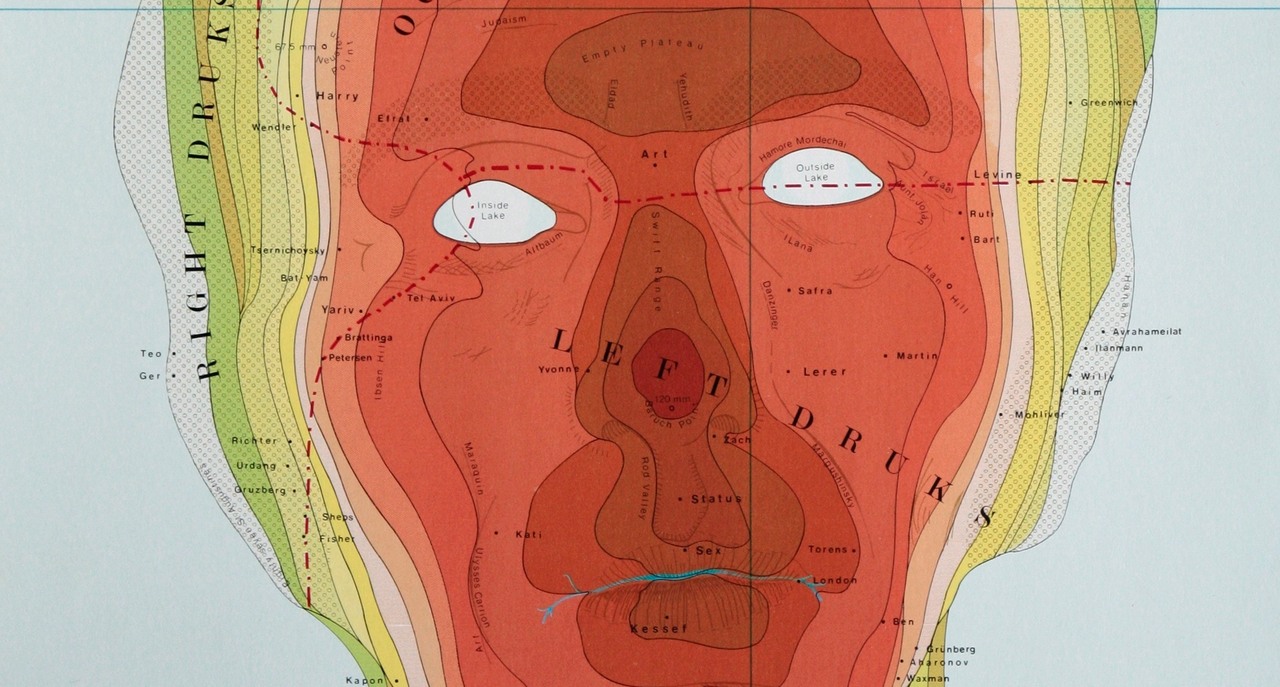
Anthropologists use life histories as a means to shed light on larger systems through the eyes of one individual, over time. Atlas Obscura author Lauren Young recently reminded readers of Michael Druks work, called Druksland. This portrait captures Druks' life story through cartography.
Detail of <em>Druksland</em>, Michael Druks cartographic self-portrait.

Young writes: Outlining the shape of his head, Druks’ conceptual map incorporates features you would see on a topographical map, including coordinates, bodies of water, and a map legend. Yet the map also serves as an unconventional self-portrait, the coordinates corresponding to major life events, significant people, and important institutions. Druks shows how the contours of a face could be a more complex terrain than any geology on Earth.

This is an interesting example of a medium where cognitive mapping and life histories may meet.

30 March 2017

Book Report Entry #3: Taking Notes from Field notes: A Guided Journal for Doing Anthropology

In our continued feature of Fieldnotes: A 'guided journal' for doing anthropology by Luis A. Vivanco, we're delving into his fourth chapter on Taking Notes in his Doing Fieldwork section of the book.

Vivianco documents the principles of good note taking which he's adapted and modified from Emerson et al. 1995. Some of these principles include:
  1. Show, don't tell or summarize events and experiences
  2. Avoid generalizing or impressionistic words
  3. Avoid projections of emotions
  4. Keep a running list of questions
Vivianco's list includes other important principles and reminds me of another blog post I read a while back on Writing Live Fieldnotes by Tricia Wang.

Wang defines live fieldnoting as: 
a blog post that is intended to provide an on-location and synchronous visual and textual coverage of an instance from the ethnographer’s fieldwork. The live fieldnote is created with a image sharing app on a mobile phone that is then shared to other social networking services. Images are accompanied by a description of the image and can also include a brief analysis of what the interaction means to the participants in the image and/or to the ethnographer. 
As part of this process, Wang highlights how these materials are accessible on the internet (although, this may be an issue in certain countries where participants can't reach some social media sites), time stamped and include locating data. Wang argues that live fieldnoting combines what she calls
two activities that are central to ethnographic research: 
  1. the ethnographer’s participation in a social world
  2. the ethnographer’s written account of the world through her/his participation. 
Live fieldnotes are typically comprised of a one to five sentences. The accumulation of many live fieldnotes works towards producing a “thick description” along with other long form fieldnotes.  Live fieldnotes are not intended to replace the entire fieldnote writing process, rather it is just one of many ways notes can be jotted down for reflection at a later point in time.
Both authors of this blog kept blogs during their PhD research (see for example, When in doubt... Map the city and make kinship charts. An Anthropologist in Amsterdam) yet, this live field notes is something different, perhaps something more 'raw'. 

To bring this discussion back to Vivianco, he writes of the importance of converting "raw" to "cooked" fieldnotes. He writes that this process of returning to the scene and adding details missing in the first "raw" take helps create a more holistic picture, what Wang (from Clifford Geertz) identifies as thick description.

**Jennifer, the author of this post, is reviewing this book from front to back; however, as she flipped through the text after having completed the first draft of this post, she came across Vivianco's own reference to Wang's work in his chapter on 'Going Digital'. Wang's post on ethnographymatters.net definitely has some fans...**

Quick Links:
Other posts from anthro averywhere!'s ongoing Book Report on Vivanco's Field Notes: